
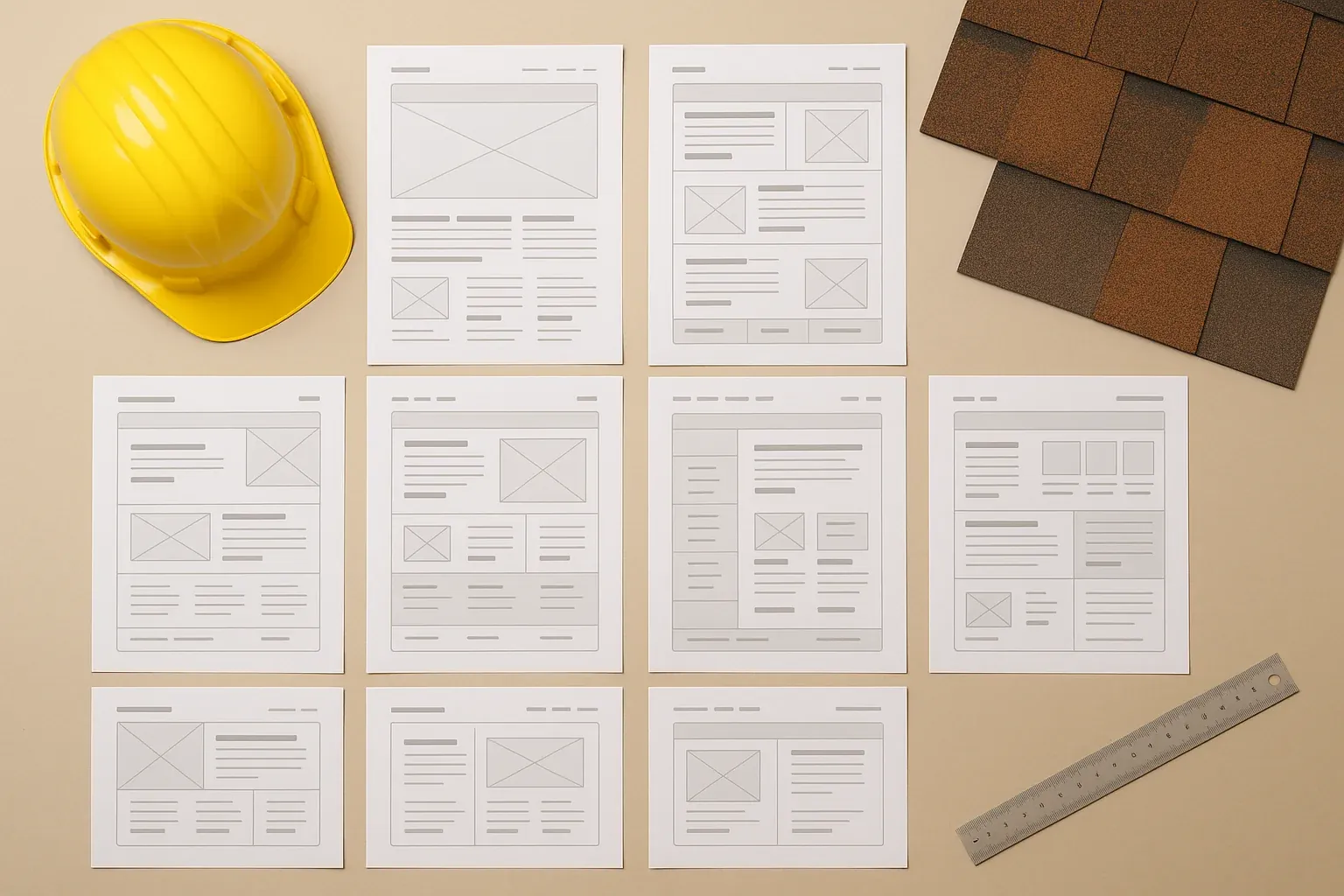
Most Roofing Websites Are Missing the Pages That Actually Close Jobs
Here’s what the typical roofing website looks like: a homepage with a stock photo of a roof, an “About Us” page, a generic “Services” page that says “We do all types of roofing,” and a contact page with a form. That’s it. Four pages, maybe five if they threw in a testimonials page.
And the owner wonders why the phone isn’t ringing.
A roofing website needs to do more than just exist on the internet. It needs to answer every question a homeowner has before they pick up the phone. It needs to rank on Google for the specific services people are searching for. And it needs to build enough trust that someone who just found you five minutes ago feels confident enough to invite you onto their roof.
Here are the seven pages every roofing website needs — and what to put on each one.
1. Homepage: Your 5-Second Pitch
Your homepage has about five seconds to convince a visitor to stay. That’s it. If they don’t immediately understand what you do, where you do it, and why they should trust you, they hit the back button and call the next guy.
What your homepage needs:
- A clear headline that says what you do and where: “Trusted Roofing Contractor Serving [City] and Surrounding Areas”
- A prominent phone number with click-to-call functionality
- Your Google review rating and count: “4.8 stars from 150+ reviews”
- A strong call-to-action: “Get Your Free Roof Inspection” or “Request a Free Estimate”
- Trust badges: licensed, bonded, insured, BBB, manufacturer certifications
- A brief overview of your services with links to individual service pages
- A few photos of real completed projects
What your homepage does NOT need: a slideshow that takes 30 seconds to cycle through, a “Welcome to our website” banner, an auto-playing video, or paragraphs of text about your company history. Save that for the About page.
2. Individual Service Pages
This is the single biggest mistake roofing websites make: lumping all services onto one generic page. Google can’t rank a page for “shingle roof replacement” AND “flat roof repair” AND “gutter installation” all at once. Each service needs its own dedicated page.
Service pages you should have:
- Shingle Roofing — asphalt shingle installation, replacement, and repair
- Metal Roofing — standing seam, corrugated, metal roof installation
- Flat/Low-Slope Roofing — TPO, EPDM, modified bitumen for commercial and residential
- Roof Repair — leak repair, storm damage, emergency repairs
- Gutter Services — gutter installation, repair, gutter guards
- Roof Inspections — pre-purchase inspections, annual inspections, insurance inspections
Each service page should include:
- A unique title and meta description targeting that specific service
- 500+ words of content explaining the service, process, materials, and benefits
- Real photos of that type of work you’ve completed
- A call-to-action with your phone number and a form
- Links to related service pages
When someone Googles “metal roof installation [your city],” Google is looking for a page specifically about metal roof installation. If you don’t have one, you’re invisible for that search.
3. Service Area Page
Roofing is a local business. Your customers are searching by city name, and Google is trying to match them with local providers. A dedicated service area page tells Google exactly where you operate.
What to include:
- A list of every city, town, and county you serve
- A map showing your coverage area
- Individual paragraphs (or even separate pages) for your primary cities: “Roofing Services in [City Name]”
- Your response time and availability for each area
For maximum SEO impact, consider creating individual city pages for your top 5-10 markets. A page titled “Roofing Contractor in [Specific City]” with content specific to that area will outrank a generic “We serve the greater metro area” page every time.
4. About Page: Your Story, Your Credibility
The About page is consistently one of the most visited pages on any contractor’s website. Homeowners want to know who they’re inviting into their home and onto their roof.
What works on a roofing About page:
- Real team photos. Not stock images. Your crew, your trucks, your office. People hire people, not logos.
- Your story. How you got into roofing, how long you’ve been doing it, what drives you. Keep it genuine — nobody wants to read corporate marketing speak.
- Credentials. License numbers, insurance information, manufacturer certifications (GAF Master Elite, CertainTeed SELECT ShingleMaster, Owens Corning Preferred). These are massive trust signals.
- Experience stats. Years in business, number of roofs completed, square footage installed.
- Community involvement. Sponsor local sports teams? Do charity work? Mention it. Homeowners like hiring businesses that invest in their community.
5. Gallery / Portfolio Page
Roofing is visual work. Before-and-after photos are the most persuasive content a roofing website can have. A homeowner who sees a photo of a deteriorating roof transformed into a beautiful new installation immediately understands the value of what you do.
How to organize your portfolio:
- By project type: Shingle replacements, metal installations, flat roofs, repairs, gutter projects
- Before and after: Side-by-side or slider comparisons showing the transformation
- Project details: Brief description of each project — scope of work, materials used, timeline, neighborhood or city
- Close-up details: Show the quality of your work — clean lines, proper flashing, neat gutter connections
You don’t need professional photography for every job. Smartphone photos are fine as long as they’re clear, well-lit, and show the work effectively. Shoot from the ground and from the roof. Capture the full house view and the close-up details.
Aim for 20+ projects in your portfolio. Update it regularly with new completions.
6. Financing Page
If you offer financing options, this page is a conversion powerhouse. Roof replacements are expensive — typically $8,000 to $25,000+ depending on size and materials. Many homeowners want a new roof but can’t pay for it all at once.
What your financing page should include:
- A clear explanation that financing is available
- General terms: “As low as $X/month” or “0% interest for 12 months” (whatever you offer)
- The application process — how easy it is to apply and get approved
- Qualifying criteria (general, not detailed credit requirements)
- A call-to-action to get a quote with financing options included
Companies that prominently display financing options on their website see significantly higher conversion rates on large projects. If a homeowner can see that their $15,000 roof replacement could be $200/month, the project suddenly feels achievable.
7. FAQ Page
Your FAQ page serves two purposes: it answers the questions potential customers have (building trust and reducing friction), and it’s an SEO goldmine because people literally type these questions into Google.
The questions homeowners actually ask about roofing:
- How much does a new roof cost?
- How long does a roof replacement take?
- Do I need a full replacement or can my roof be repaired?
- What type of roofing material is best?
- Will my insurance cover roof damage?
- How do I know when my roof needs to be replaced?
- What happens if it rains during my roof installation?
- Do you handle the permit and inspection process?
- What warranty do you offer?
- How do I get a free estimate?
Write genuine, detailed answers to each of these questions. Don’t give one-sentence replies — write 100 to 200 words per answer. This content helps Google understand your expertise, and it helps homeowners feel confident about calling you.
Putting It All Together
Seven pages might sound like a lot, but think of it this way: each page is a separate entry point to your business. Each one ranks independently on Google, each one answers a different customer question, and each one brings a visitor one step closer to picking up the phone.
A roofing website with these seven pages will outperform a five-page template site every single time — in rankings, in traffic, and most importantly, in signed contracts. The homeowner who finds your detailed metal roofing page, reads your FAQ, looks at your portfolio, and sees your financing options isn’t just a lead — they’re practically a closed deal before they even call you.
Webpage Workmen
We build modern, lightning-fast websites exclusively for tradesmen. Plumbers, electricians, HVAC techs, roofers — we speak your language and we are here to help your business grow online.