Google has been waging war on fake reviews for years. But in 2025, they turned up the heat significantly — and contractors across the country are feeling the impact.
If you’ve been building your review count honestly, this is good news. If you’ve been cutting corners, or if your competitors have, the landscape is about to shift. Here’s what’s happening and what it means for your business.
What Google Changed
Google has always had policies against fake, incentivized, and manipulated reviews. But enforcement was inconsistent. Businesses could buy reviews from overseas click farms, offer customers gift cards in exchange for five-star ratings, or have employees post reviews — and often get away with it for months or years.
That’s changing. Google rolled out significantly improved detection systems that use machine learning to identify suspicious review patterns. These systems look for:
- Sudden spikes in review volume that don’t match a business’s typical pattern
- Reviews from accounts with no other activity (accounts created solely to post one review)
- Geographic inconsistencies — reviews from people nowhere near the business’s service area
- Linguistic patterns common to paid review services (certain phrases, sentence structures, and review lengths that paid reviewers tend to use)
- Device and IP clustering — multiple reviews coming from the same device, network, or location
- Incentivized language — reviews that mention receiving something in exchange (“they gave me a discount for this review”)
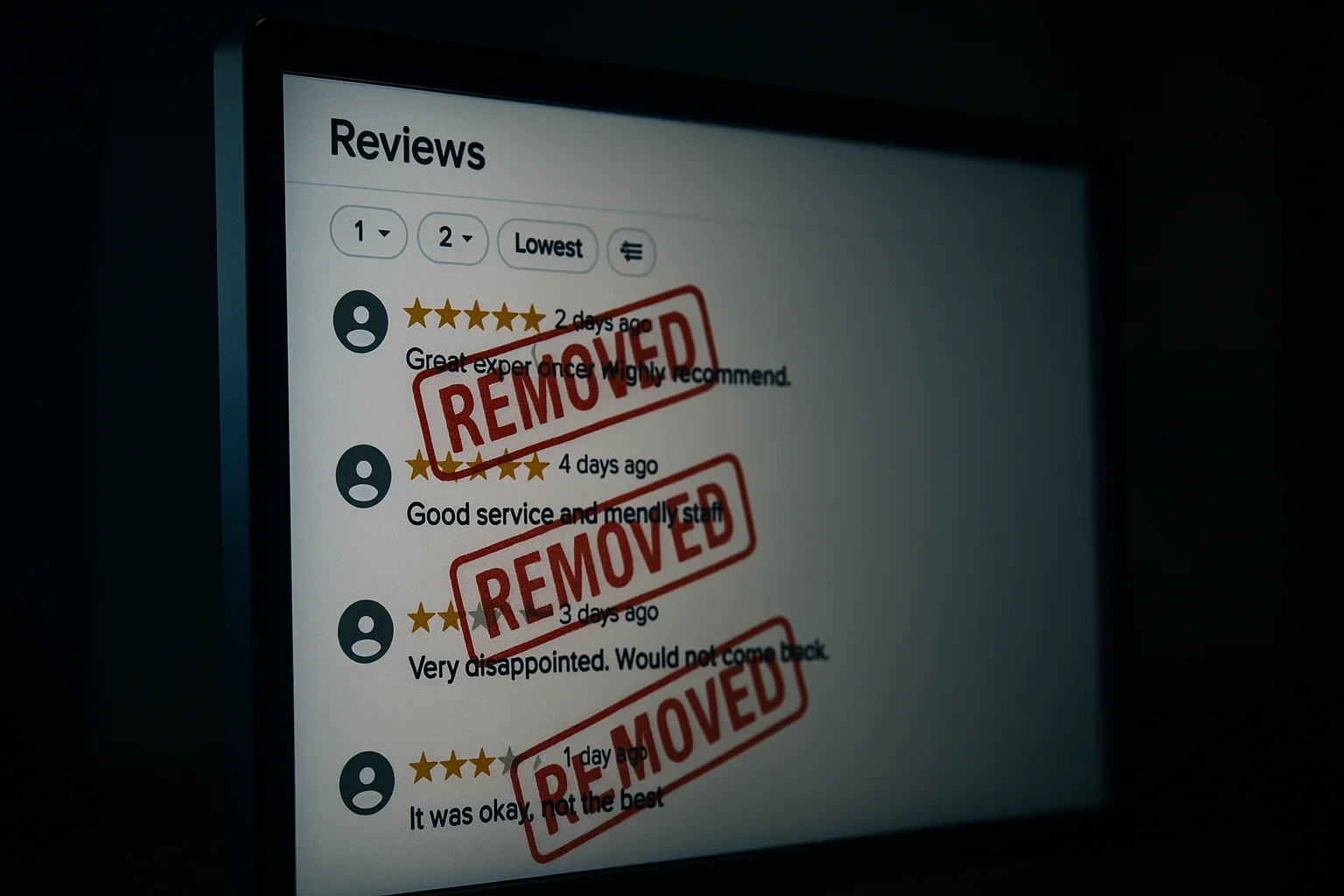
When Google’s systems flag reviews as suspicious, they’re removed. Sometimes in batches. Businesses that had inflated their ratings with hundreds of fake reviews have seen their review counts drop dramatically overnight.
Real Consequences Are Hitting Real Businesses
The impact has been substantial. In major metros across the US, home service businesses have lost significant portions of their review counts. Some of the more notable patterns:
Businesses dropping from 500+ reviews to under 100. These were operations that had been aggressively purchasing reviews for years. When Google swept their profiles, the real review count was a fraction of what was displayed.
Star ratings plummeting. When you remove 400 fake five-star reviews and leave the 80 real ones — which include some three and four-star ratings — the average drops. Businesses that showed a pristine 4.9 suddenly sat at 4.2 or lower.
Ranking losses in the Local Pack. Since review quantity and quality are significant factors in Google’s local ranking algorithm, businesses that lost reviews also lost their position in the coveted top-3 map results. Competitors who had always done reviews honestly suddenly found themselves ranking higher.
Google has also started applying “review fraud” flags to Google Business Profiles. While the exact mechanisms aren’t fully public, businesses flagged for review manipulation can face restricted features or reduced visibility.
Why Buying Reviews Was Always a Bad Bet
Even before Google’s crackdown, purchased reviews were a liability:
The FTC is watching. The Federal Trade Commission has made it clear that fake reviews violate consumer protection laws. In 2023, they proposed a rule that would impose fines of up to $50,000 per fake review. That rule has been moving through the regulatory process and enforcement actions have already begun.
Customers can often tell. Reviews that all sound the same, all appeared within a few days, or all give vague generic praise (“Great service! Would recommend!”) are obvious to savvy consumers. People read reviews carefully before hiring a contractor — they notice patterns.
It creates a fragile foundation. Building your online presence on fake reviews means one algorithm update can wipe out years of “effort.” Building on legitimate reviews creates a foundation that only gets stronger over time.
How to Build a Legitimate Review Strategy
If you’ve been doing reviews the right way, double down on that approach. Here’s what works:
Ask Consistently, Not Occasionally
The most effective review strategy is also the simplest: ask every satisfied customer for a review. Not just the big jobs. Not just when you remember. Every single one.
Create a system. After completing a job, send a text message or email with a direct link to your Google review page. Do this within 24 hours while the experience is fresh. Most customers are happy to leave a review — they just need to be asked and given an easy way to do it.
Make It Frictionless
The harder it is to leave a review, the fewer you’ll get. Create a short URL or QR code that goes directly to your Google review submission form. Include it on:
- Follow-up text messages after service
- Printed cards you leave with customers
- Your email signature
- Your invoice or receipt
Respond to Every Review
Responding to reviews signals to both Google and potential customers that you’re engaged and professional. For positive reviews, a genuine thank-you that mentions something specific about the job shows authenticity. For negative reviews, a calm, professional response shows you take concerns seriously.
Businesses that respond to reviews earn 12% more revenue on average, according to Harvard Business School research. Google has also confirmed that review responses factor into local ranking.
Focus on Review Velocity
Google’s algorithm favors businesses with a steady stream of recent reviews over those with a large batch of old ones. Getting 2-3 reviews per week consistently is more valuable than getting 30 in one month and then going silent.
This is another reason to make review requests a standard part of your workflow rather than an occasional campaign.
Don’t Incentivize
Google’s policies are explicit: you cannot offer anything of value in exchange for a review. No discounts on future service. No gift cards. No entry into a raffle. Not only does this violate Google’s terms, but it also creates the kind of review pattern that their detection systems are specifically designed to catch.
You can (and should) ask for reviews. You can make it easy to leave reviews. You cannot pay for them in any form.
The Opportunity for Honest Businesses
Here’s the part that should excite you: Google’s crackdown on fake reviews is leveling the playing field. If you’ve been competing against businesses with inflated review counts and fake five-star ratings, those artificial advantages are disappearing.
The contractors who will thrive in this new environment are the ones who:
- Do consistently good work that earns genuine positive reviews
- Have systems in place to request reviews from every customer
- Respond professionally to all feedback
- Build their review count steadily over time
If that describes you, you’re positioned to gain ground against competitors who relied on shortcuts.
What to Do Right Now
-
Audit your own reviews. Make sure all your reviews are legitimate. If you’ve ever used a review generation service or had employees post reviews, understand that those could be removed.
-
Set up a systematic review request process. If you don’t have one, start today. A simple text message after every completed job is the foundation.
-
Check your competitors. Search for your top competitors and look at their review profiles. If you see sudden drops in their review counts, their fake reviews got caught — and that’s an opportunity for you.
-
Diversify beyond Google. While Google reviews are the most important, also build reviews on Yelp, BBB, Angi, and industry-specific platforms. A presence across multiple platforms reinforces your legitimacy.
-
Document your review process. If you ever face questions about your review practices, having a documented, above-board process protects you.
The era of buying your way to a five-star rating is ending. The era of earning it is here. For contractors who’ve always done it right, that’s the best news in years.
Webpage Workmen
We build modern, lightning-fast websites exclusively for tradesmen. Plumbers, electricians, HVAC techs, roofers — we speak your language and we are here to help your business grow online.