
Your Website Should Be Booking Jobs, Not Just Sitting There
We’ve looked at hundreds of plumbing websites across the country. The pattern is always the same: a homepage with a stock photo of a wrench, a paragraph about “quality service since 1998,” a contact page with a form nobody fills out, and that’s it. No wonder the phone isn’t ringing.
A plumber’s website has one job: turn visitors into phone calls. Every element on your site should be working toward that goal. Here are the five things that make the difference between a website that generates leads and one that just takes up space on the internet.
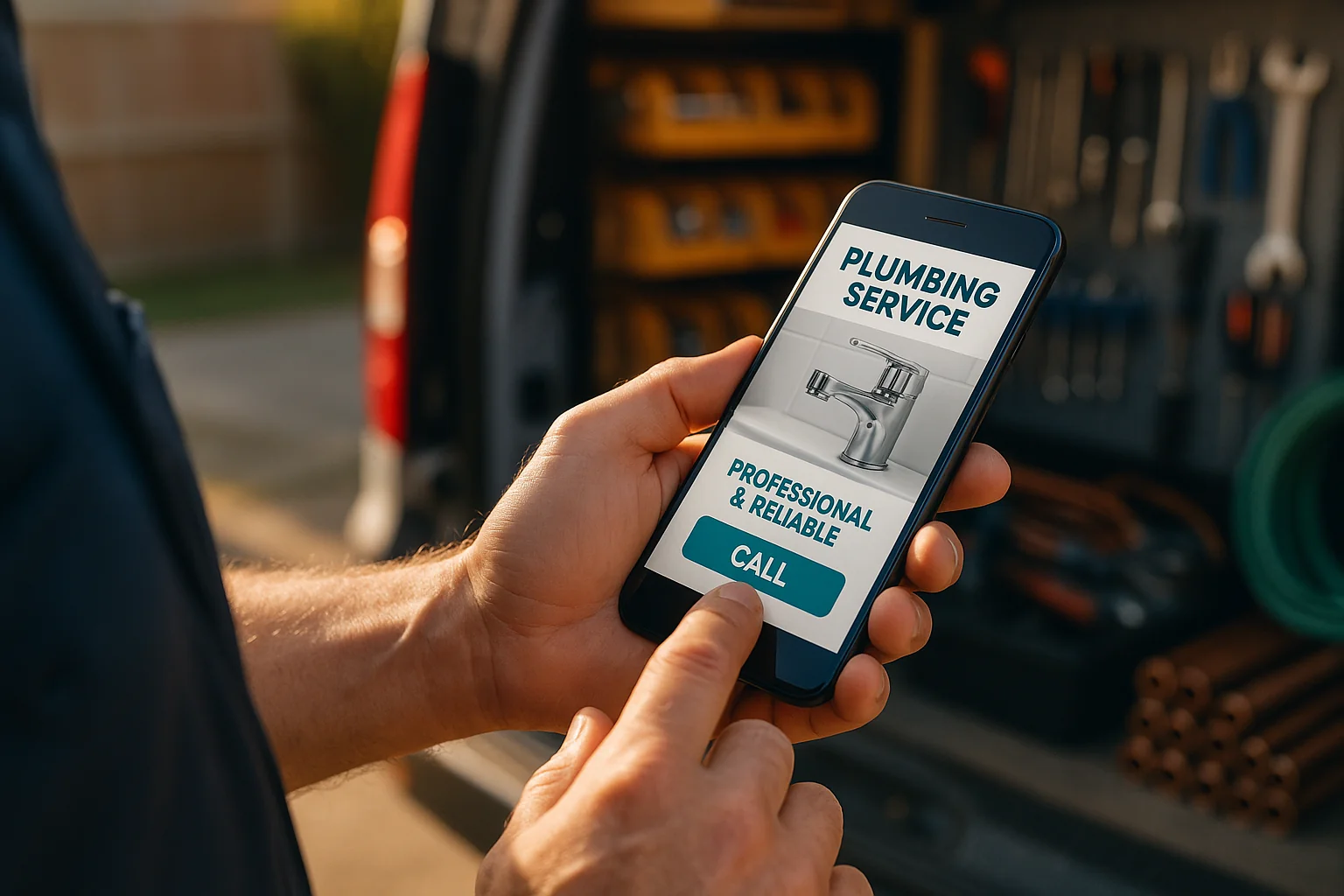
1. A Click-to-Call Button on Every Single Page
This is the most important thing on your website, and it’s the one most plumbing sites get wrong. Your phone number needs to be:
- In the header — visible without scrolling on every page
- Clickable on mobile — when someone taps it, their phone should start dialing immediately
- Big and obvious — not tucked into a corner in 12-point font
Here’s why this matters so much: according to Google, 60% of mobile searchers call a business directly from search results using a click-to-call button. For plumbing specifically, many customers are dealing with an emergency — a burst pipe, a backed-up sewer, a water heater that just died. They’re not going to sit down and fill out a contact form. They need to call someone right now.
If your phone number isn’t immediately visible and tappable on mobile, you’re losing emergency calls to the competitor whose number is easier to find.
Pro tip: Include a sticky header or floating call button on mobile that stays visible as people scroll. That way, no matter where they are on your site, one tap gets them on the phone with you.
2. A Service Area Page with Real Location Targeting
“We serve the greater Tampa Bay area” is not good enough. You need a dedicated service area page — and ideally individual city pages — that list every specific city, town, and neighborhood you serve.
Here’s why: when a homeowner in Riverview, Florida searches “plumber in Riverview,” Google is looking for pages that specifically mention Riverview. If your website only says “Tampa Bay area,” you’re going to lose that search to the plumber who has a page specifically optimized for Riverview.
Your service area page should include:
- A list of every city and neighborhood you cover
- A map showing your coverage area
- Specific content for your primary service cities (even a paragraph or two about each one)
- Your response time for each area
This is one of the easiest SEO wins for any local plumbing business, and almost nobody does it properly.
3. Real Photos of Your Team, Trucks, and Completed Work
Homeowners can spot stock photos from a mile away. And when they see a generic image of a smiling model pretending to be a plumber on your website, it sends one clear message: “This company isn’t real enough to show me who they actually are.”
Your website needs real photos of:
- Your team — even if it’s just you. A photo of a real person builds trust faster than anything else on your site.
- Your trucks and equipment — show that you’re a legitimate, equipped operation.
- Completed jobs — before-and-after photos of real work you’ve done. Tankless water heater installations, re-piping projects, bathroom rough-ins, drain cleaning jobs.
You don’t need a professional photographer. A smartphone camera is perfectly fine. Just make sure the photos are well-lit, in focus, and show real work. A slightly imperfect real photo beats a perfect stock photo every single time when it comes to building trust.
What to photograph:
- The finished product after a clean installation
- Your team in uniform at a job site
- Your branded truck parked at a customer’s house
- Before-and-after shots of any visible work (think water damage repair, new fixture installations)
4. Reviews and Trust Signals Front and Center
Your Google reviews are probably the most valuable marketing asset you have. So why are they buried on a separate “Testimonials” page that nobody visits?
Your reviews and trust signals should be visible on your homepage, above the fold or right below the hero section. Here’s what to display:
- Your Google rating and review count — “4.8 stars from 127 reviews” is one of the most powerful lines of text your website can show.
- Selected customer quotes — pull 3 to 5 of your best Google reviews and display them prominently.
- License and insurance information — your state contractor license number, proof of insurance, and bonding information.
- Industry affiliations — Better Business Bureau, local chamber of commerce, trade association memberships.
- Years of experience — “Serving Tampa since 2005” tells homeowners you’re not going to disappear after the job.
According to BrightLocal, 87% of consumers read online reviews for local businesses. And for home services specifically, reviews are the number one factor that determines whether someone calls you or your competitor.
5. An Emergency Service Callout Above the Fold
Plumbing emergencies drive a massive percentage of plumbing revenue. When a pipe bursts at 2 AM, the homeowner grabs their phone and calls the first plumber who looks like they can handle an emergency.
Your website needs to communicate “we handle emergencies” within the first second someone lands on your homepage. This means:
- A prominent banner or badge — “24/7 Emergency Service” or “Same-Day Emergency Plumbing” should be one of the first things visitors see.
- A separate emergency phone number or at minimum, clear messaging that your main number is answered 24/7.
- An emergency services page — a dedicated page that lists the types of emergencies you handle, your response time, and what homeowners should do while they wait.
Think about the psychology here. A homeowner with water pouring out of their ceiling isn’t going to carefully read your “About Us” page. They’re scanning for two things: “Do they handle emergencies?” and “What’s their phone number?” If your site answers both of those questions in under three seconds, you’ll get the call.
What About Everything Else?
These five elements are the foundation. Without them, nothing else on your site matters much. But once you have these dialed in, you can start building on top of them:
- Individual service pages for each type of plumbing work you do (water heater installation, drain cleaning, sewer line repair, etc.)
- A blog with helpful content about common plumbing problems
- A financing page if you offer payment plans
- An FAQ page answering the questions you hear most from customers
The Takeaway
Most plumbing websites are built like online brochures — they look okay and they have some information, but they’re not designed to generate leads. If your site is missing any of these five elements, you’re leaving money on the table every single day.
The fix doesn’t have to be expensive or complicated. But it does have to happen. Every day your website sits there without a click-to-call button, without real photos, without emergency messaging — that’s another day your competitors are picking up the calls that should be going to you.
Webpage Workmen
We build modern, lightning-fast websites exclusively for tradesmen. Plumbers, electricians, HVAC techs, roofers — we speak your language and we are here to help your business grow online.